

By A. Wayne Ferens
Images courtesy of Ferens collection and Chrysler Corp.
Edited by MotorCities National Heritage Area Staff
Part 2 in the MotorCities Story of the Week "Letter Series"
Published 09.23.2026
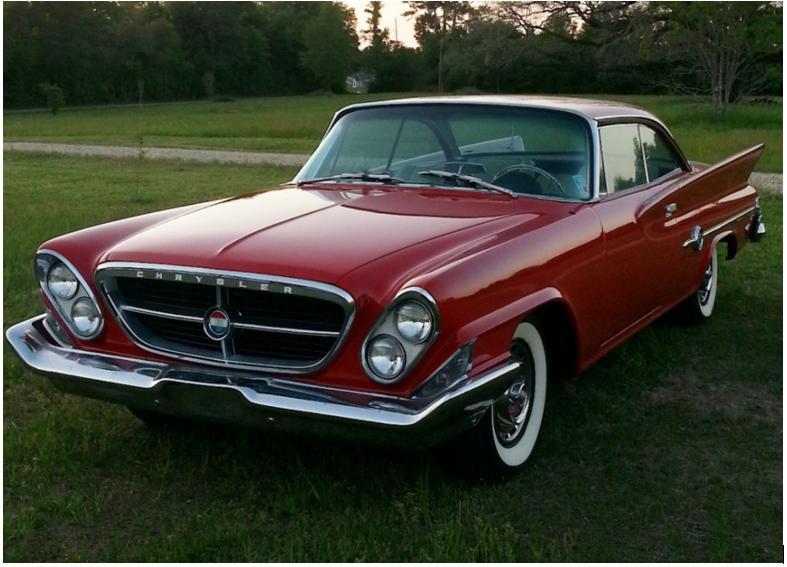
The 1961 Chrysler 300G was still among the most powerful and luxurious cars available. On the outside, Chrysler revised the grille again. The grille, which had formerly been wider at the bottom than the top, was inverted. The quad headlights, which had always been side by side, were now stacked at an angle, giving the car a wider appearance. Small parking lamps below the headlights were likewise slanted and V-shaped. At the rear, the taillights were removed from the fins and placed just above the rear bumper. The front bumper was canted upward at each end.
With automotive styling beginning to change, the 300G would be the last Letter Series car to sport Virgil Exner's big fins. The controversial faux spare tire on the trunk was also eliminated.
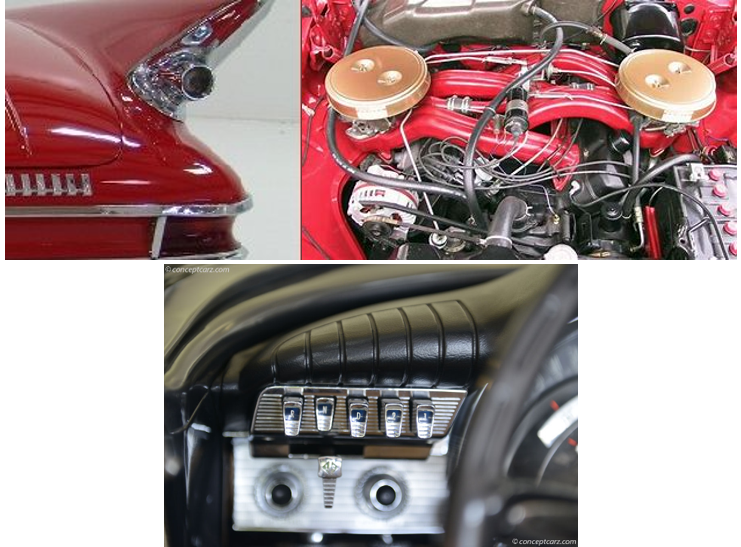
Power windows were now standard, and more luxury features were available, including power seats, air conditioning, a rear defogger, tinted glass and a power antenna. The 413-cubic-inch V-8 carried over from 1960, producing 375 horsepower as standard and 400 horsepower with the optional high-output engine. The TorqueFlite three-speed automatic was standard, while a three-speed manual was available. The French-made Pont-a-Mousson four-speed transmission used in the 1960 300F was dropped for 1961 and replaced by a Chrysler heavy-duty three-speed manual transmission. The special transmission was referred to as option code 281. Some code 281 cars may have been prepared for the 1961 Daytona Flying Mile, although Chrysler did not maintain specific production records for those cars.
Chrysler had a unique dash design it called the AstraDome, introduced in 1960 and used through 1962. It used electroluminescent lighting rather than conventional bulbs, and the speedometer went to 150 mph. It really added a touch of class to an already beautiful interior.
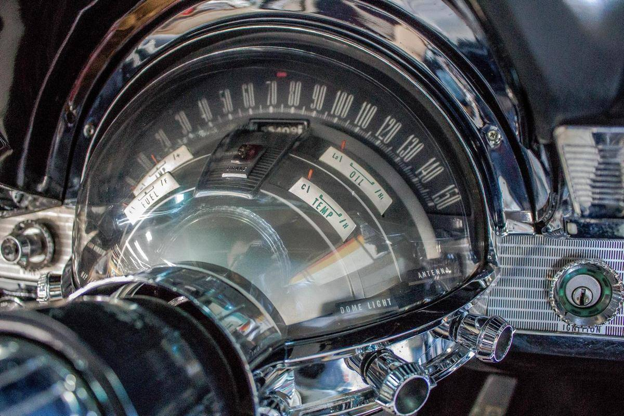
Photos: Ferens collection
Production increased again in 1961, with 1,617 300Gs built. Of those, 1,280 were coupes and 337 were convertibles. The base price was $4,952 for the coupe and $5,352 for the convertible, according to Chrysler 300 Club records.
1962 Chrysler 300H
The 1962 Chrysler 300H received a dramatic change in appearance. The front-end styling was revised, and the fins were gone. The 300H was also shorter and about 300 pounds lighter than the previous year's 300G. All 1962 Letter Series cars rode on a 122-inch wheelbase.
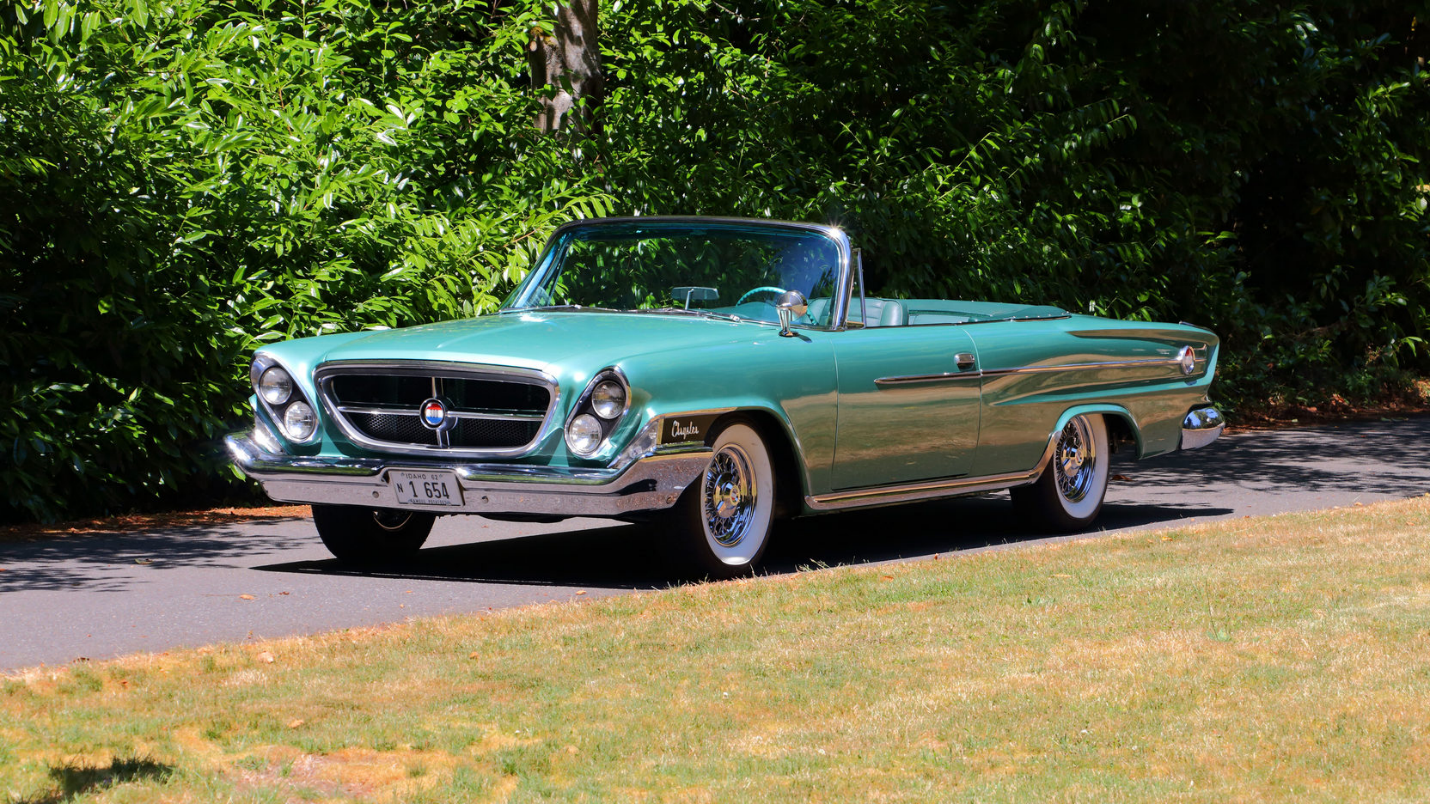
For 1962, Chrysler also introduced the 300 Sport Series, which included a two-door hardtop, four-door hardtop and convertible. The non-letter 300 Sport models shared much of the 300H's styling, equipment and performance potential. That made the considerably more expensive Letter Series car less exclusive than it had been in previous years.
Under the hood, the 413-cubic-inch V-8 was back up to 380 horsepower. The standard engine returned to the inline dual four-barrel carburetor setup used on the 300E. The cross-ram engine became an option, with the high-output version rated at 405 horsepower. With the additional power and lighter body, the 300H was quicker than the previous year's 300G.
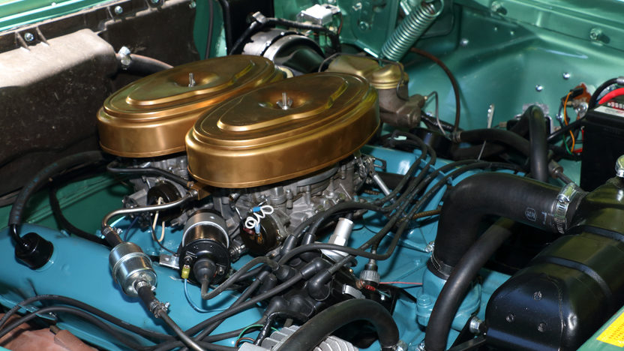
The 300H had a 122-inch wheelbase, compared with 126 inches for the 300G, and weighed about 300 pounds less. Prices started at $5,090 for the coupe and $5,461 for the convertible.
Only 558 300Hs were produced in 1962, including 435 coupes and 123 convertibles. That made 1962 the lowest-production year for the Letter Series to that point. The 300 Sport Series, which offered much of the 300H's equipment at a lower price, undoubtedly made the 300H a tougher sell.
1963 Chrysler 300J
The 1963 Chrysler 300J was offered only as a two-door hardtop. Chrysler skipped the letter "I," apparently because it could be confused with the number 1. The 300J continued the trend toward a smoother, more angular appearance, with the headlights once again positioned side by side.
The 1963 redesign marked the end of Virgil Exner's tenure as Chrysler's styling chief. The new body was developed under Elwood Engel's design leadership, although it still carried some of the influence of the previous styling era.
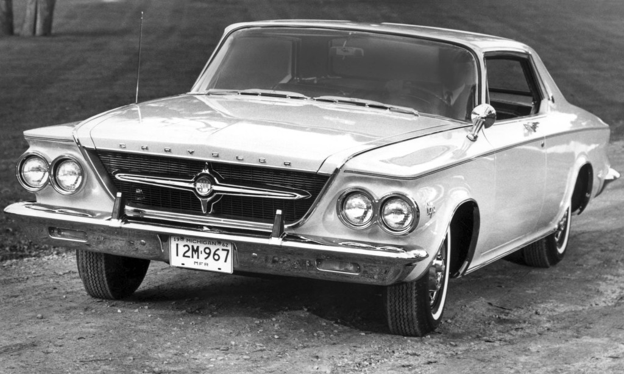
Photo from Chrysler Corporation
Inside, the 300J featured a redesigned and more luxurious interior, including an unusual squared-off steering wheel and the familiar 150-mph speedometer. Gone was the electroluminescent AstraDome instrument cluster, replaced by a more conventional instrument panel. The 300J retained leather upholstery, power windows and a number of other luxury features as standard equipment.
The biggest news for Chrysler in 1963 was not limited to the 300J. Chrysler introduced its famous five-year or 50,000-mile powertrain warranty on its 1963 passenger cars. The warranty covered major powertrain components, including the engine, transmission, driveshaft and rear axle. At the time, it was an unusual move in the American automobile industry and became one of Chrysler's most notable selling points.
The 300J was equipped with a 413-cubic-inch ram-induction V-8 rated at 390 horsepower. A heavy-duty three-speed manual transmission was available at no extra charge, while the TorqueFlite automatic was standard. The 300J could reach approximately 140 mph, making it one of the fastest American luxury cars of its day.
Sales of the 300J were especially poor, with only 400 produced. That remains the lowest production figure of any Chrysler 300 Letter Series model from 1955 through 1965.
1964 Chrysler 300K
The 1964 Chrysler 300K proved one thing: price sells cars.
After the disappointing sales of the 300J, Chrysler made significant changes for 1964. The convertible returned to the Letter Series, and the price of the two-door hardtop dropped dramatically. The 300K started at $4,056 for the hardtop and $4,522 for the convertible. Those changes helped make the 300K the best-selling Letter Series car ever, with 3,647 produced, including 3,022 hardtops and 625 convertibles.
The car cost less because some of the expensive features that had been standard on previous Letter Series cars were now optional. Leather upholstery, for example, was no longer standard. The automatic transmission selector also moved from the familiar dash-mounted push buttons to a floor-mounted console. A four-speed manual transmission was available at no additional charge.
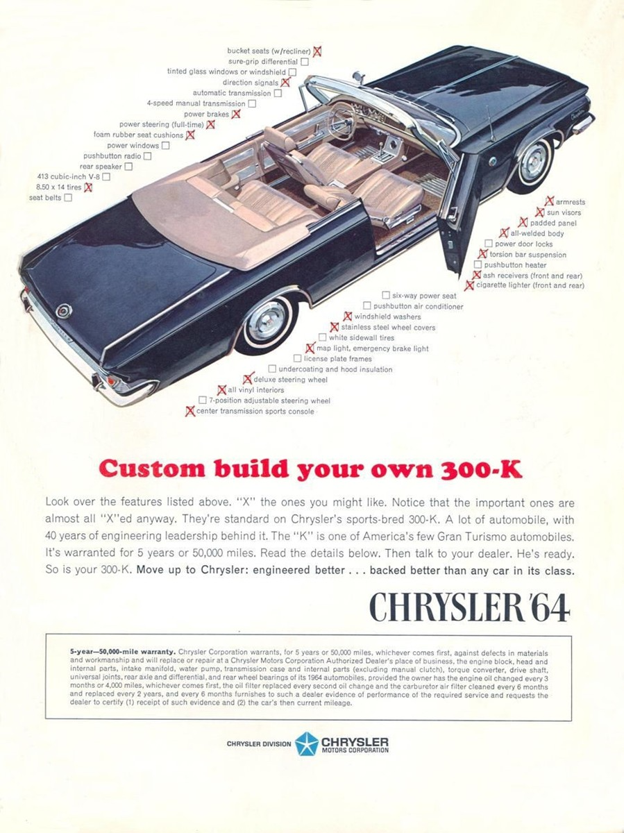
The standard engine was a 413-cubic-inch V-8 with a single four-barrel Carter AFB carburetor, rated at 360 horsepower. The 390-horsepower ram-induction 413 from the previous year was available as an extra-cost option. The speedometer now topped out at 120 mph rather than the 150-mph speedometer used on earlier Letter Series cars.
The 300K was still a beautiful and powerful car, but Chrysler was clearly moving the Letter Series closer to the mainstream.
1965 Chrysler 300L
The 1965 Chrysler 300L was the last of the original Letter Series 300 cars. Like every other 1965 Chrysler, it received an entirely new body with crisp lines, slab sides and a taller greenhouse. The new styling reflected the influence of Elwood Engel, who had succeeded Virgil Exner as Chrysler's styling chief.
The 300L was more mainstream than its predecessors, with long, straight lines and a much cleaner front end. Unfortunately, the cars no longer had the same visual distinction that had made the earlier Letter Series models so special.
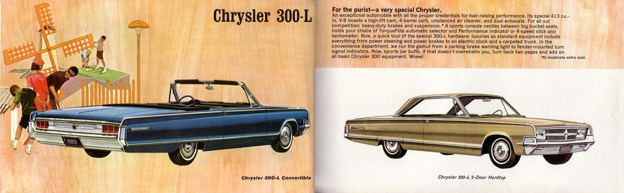
Nearly every feature available on the 300L was also available, either as standard equipment or an option, on the regular 300. The 300L did have its own exterior trim, badging and other details to distinguish it from the less expensive 300.
The 300L no longer offered a cross-ram engine. The only engine available was the 413-cubic-inch V-8 with a single four-barrel carburetor, rated at 360 horsepower. The TorqueFlite three-speed automatic remained standard, while a four-speed manual transmission was available. The 300L rode on a 124-inch wheelbase.
Chrysler built 2,845 300Ls in 1965, including 2,405 hardtops and 440 convertibles. Although the 300L sold considerably better than the 300J, the Letter Series had clearly lost much of the exclusivity that had defined it in earlier years.
One of the most interesting features of the 1965 300L was its one-year-only illuminated grille medallion. The medallion was incorporated into the center of the grille and was designed to illuminate when the car was running. Because regulations concerning such lighting differed among the states, the light was not connected at the factory. Dealers could activate it where permitted.
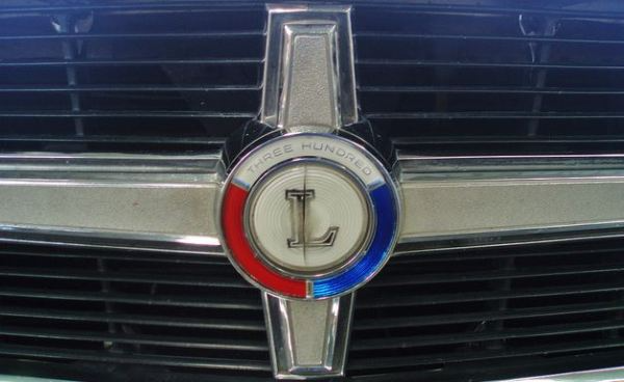
Photo from Chrysler Corporation
Looking back at the 300 Letter Series from 1961 through 1965, it is easy to see how quickly the automobile industry was changing. The 300G represented the final expression of Virgil Exner's dramatic Forward Look, while the 300H began the move toward smaller, lighter and more conservative styling. The 300J brought a completely new direction, the 300K showed that a lower price could bring buyers back, and the 300L brought the original Letter Series to an end.
For me, that 10-year run is what makes these cars so fascinating. Each one represents a different chapter in Chrysler's history, but they all share the same basic idea: combining serious performance with luxury and distinctive styling. They were never just ordinary Chryslers with a bigger engine. They were the "Beautiful Brutes," and that is what makes them so special to me.
For anyone interested in the Chrysler Letter Series and the 300's remarkable 10-year run, I highly recommend joining or contacting the Chrysler 300 Club International. The club's website is filled with history, technical information, restoration resources, stories and information about acquiring these beautiful, unique automobiles. The club is dedicated to preserving the 1955-1965 Letter Series cars and remains one of the best resources for anyone who wants to learn more about them.
Bibliography:
Chrysler Brochures
Standard Catalog of American Cars 46 - 75 by John Gunnell
The Chrysler 300 Club
Chrysler Advertising
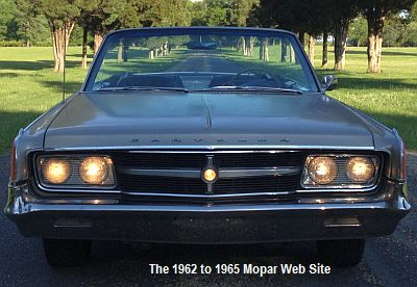
The '62 to '65 Mopar Web Site