

By A. Wayne Ferens
Published 04.01.2026
With the growing popularity of "factory built" - off the showroom floor street-legal, high-performance cars like the 406 & 427 Galaxies, 409 Chevy Impalas, 421 Pontiac Catalinas and Max-Wedge Mopars the NHRA (National Hot Rod Association) Stock and Super-Stock classes were getting crowded. NHRA needed to get creative....
By the mid-1960s Ford Engineering was well versed on how a drag car moves down the dragstrip on a typical all-out run. Factors like weight distribution, engine location, tire grip, acceleration rates, speed and distance coverage w/time, rpm changes when the clutch is engaged and disengaged, proper lubrication, safety features etc., etc.. The bottom line - low mass, high power and exceptional traction were the key ingredients for success. Extensive testing was done on Fords new Mustang and Mercury Comet drag cars that were powered by the new SOHC 427 race engine modified to compete (originally in NASCAR), in the NHRA A/FX class.
The 'FX' category was started in 1962 with three simple classes based on pounds per cubic inch. As more factory involvement grew it became more difficult for the NHRA to maintain a level playing field. By 1965 the level of factory involvement, big money and innovation created some wild-looking machines that got to the point where the benefit wasn't worth the investment.
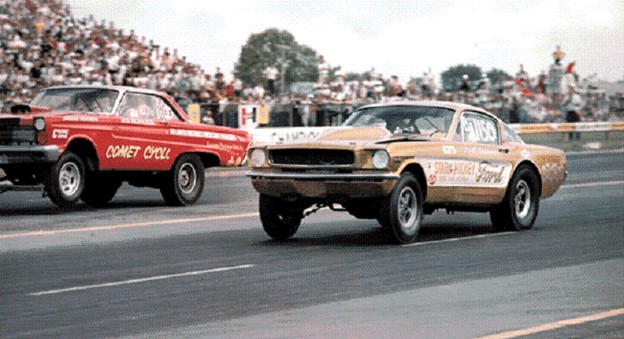 A/FX cars with altered wheelbase put on a show with off the ground acceleration. These cars were cranking out 600+ horsepower and would produce quarter mile times in the 10-11 second range with speeds topping 125 mph. Impressive for 1965 technology. Photo: Ferens collection.
Starting in 1966 to keep the race fans excited, NHRA rolled the remnants of FX into more liberal Experimental Stock (XS) and Match Bash classes thus creating extreme machines called "Funny Cars." The adrenaline that keeps race fans coming to the drags is 'speed'....mind blowing speed - pure and simple. Now, instead of those fans looking at those 11-second 125 mph A/FX drag racers like the Fairlane 427 Thunderbolt they can now witness these new hi-tech, fuel injected-nitro-burning 1000 hp flip-top 'Funny Cars' crossing the quarter mile in 7-8 seconds at 170+ mph over the next five years.
Chrysler, was rumored to be developing radical appearance changes and modifications to its team cars for the 1966 season. Forty-four year old drag racing legend Francisco 'Fran' Hernandez now head of Lincoln-Mercury's racing programs (later Trans-Am programs) was two steps ahead. His idea was to develop a light-weight true tube-chassis car with a fiberglass tilt body. It would be powered by the Engine & Foundry (E&F) 427 SOHC V8 engine.
Ford contacted the Logghe Stamping Company in Fraser, Michigan to construct four (a 5th Stage 1 chassis was later built) chromoly tube chassis that would sport a full size one piece, flip-top, fiberglass '66 Mercury Comet body. The custom body was made by Plastigauge Corporation of Jackson, MI and weighed a mere 225 pounds. The steering and front suspension would consist of a tube-style straight front axle with coilover shocks and utilizing a 9:1-ratio steering box, riding on Halibrand wheels with 10.75 inch low pressure, M&H "wrinkle wall" slicks in the rear.
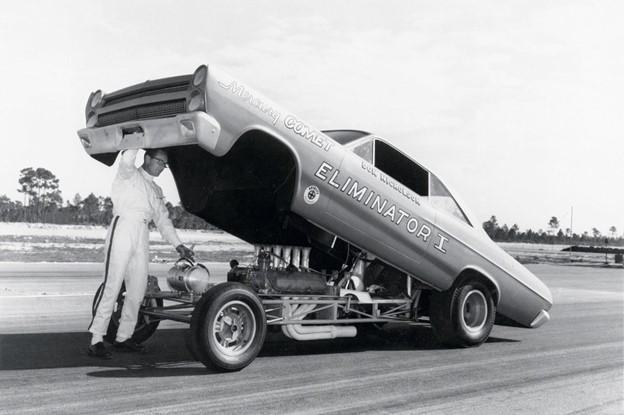 Mercury's tube framed flip-top '66 Comet was revolutionary and the first such car to crack the 7s. Late in the season Nicholson's Eliminator 1 became airborne at the finish line at Cecil County Dragway in Maryland, but not before amassing an 86-percent winning record that put these Comet flip-tops in the racing history books. Photo: Ferens collection.
To power this revolutionary Comet drag cars was Fords 427 cubic inch SOHC V8 engine keeping the stock bore and stroke with a 10.75:1 compression ratio, Crane camshafts and Hilborn fuel injection burning a mix of 80% nitromethane. The engine produced over 1000 horsepower and was mated to a Ford C-6 automatic transmission and 4000 RPM stall converter.
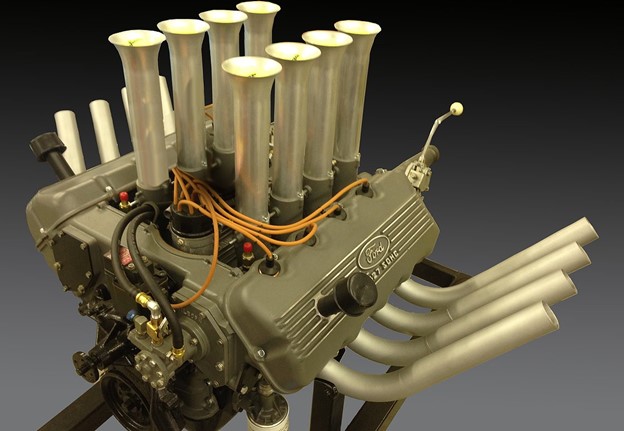 In January 1964 Ford Motor Co. received word that Bill France at NASCAR rejected their application to race cars powered by overhead cam engines. Fords E&F Division quickly prepared and tested the new SOHC engine for the NHRA drag racing circuit. Photo: Ferens collection.
Throughout the '66 racing season some modifications were made. Upgrades to the C-6 automatic transmission and 11.00x16 inch M&H slicks were used. All five cars that were built were painted by custom painter Paul Shedlick. The four teams were: Don Nicholson, the team of Ed Shartman & Roy Steffey, and Colorado's Kenz and Ron Leslie ran Comet coupes.
Jack Chrisman took a slightly different direction on his car placing a topless, roadster-style fiberglass body atop his well-engineered Logghe built chassis and called it the Big Red Kendall GT-1.
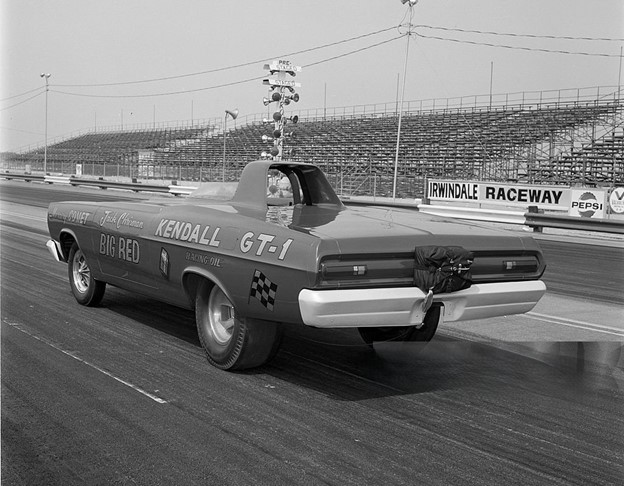 Here it is being tested at Irwindale Raceway and was powered by a supercharged 427 SOHC engine. It was certainly an outstanding "crowd pleaser" and the talk of the drags until it crashed and burned at the 1966 Super Stock Nationals doing 176 mph....
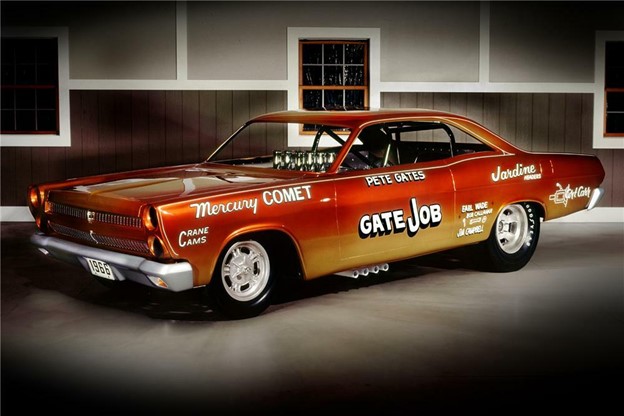
The only surviving A/FX chassis named the 'Gate Job' was driven by Pete Gates who was the 1966 NHRA National Champion. He later sold the car that passed on to several owners. The disassembled car ended up in Ohio and sold in the late 1980s. The owner who purchased the Gates Flip-Top restored the car and retains its all original body, running gear, wheels, chassis and factory magnesium parts. It was put up for auction where it sold in January 2009 at Barrett-Jacksons in Arizona. It has been displayed many times at NHRA events and auto shows around the country.
Bibliography:
Hot Rod Magazine April 1966
Barrett-Jackson Auction Catalog
Drag Racing in the 1960s by Doug Boyce
Don Nicholson web site
Photos: Ferens collection