


By A. Wayne Ferens
Published 05.20.2026
Edited by MotorCities National Heritage Area Staff
Introduced in 1957 as a truck version of the Ford Custom sedan, the seven generations of Ranchero lived on until 1979 and shared underpinnings with iconic cars like the Falcon, Fairlane, Torino and LTD models that were being sold by Ford for the North American market. Designed as a coupe utility the Ranchero was the first of its kind that integrated the cab and cargo bed into the body.
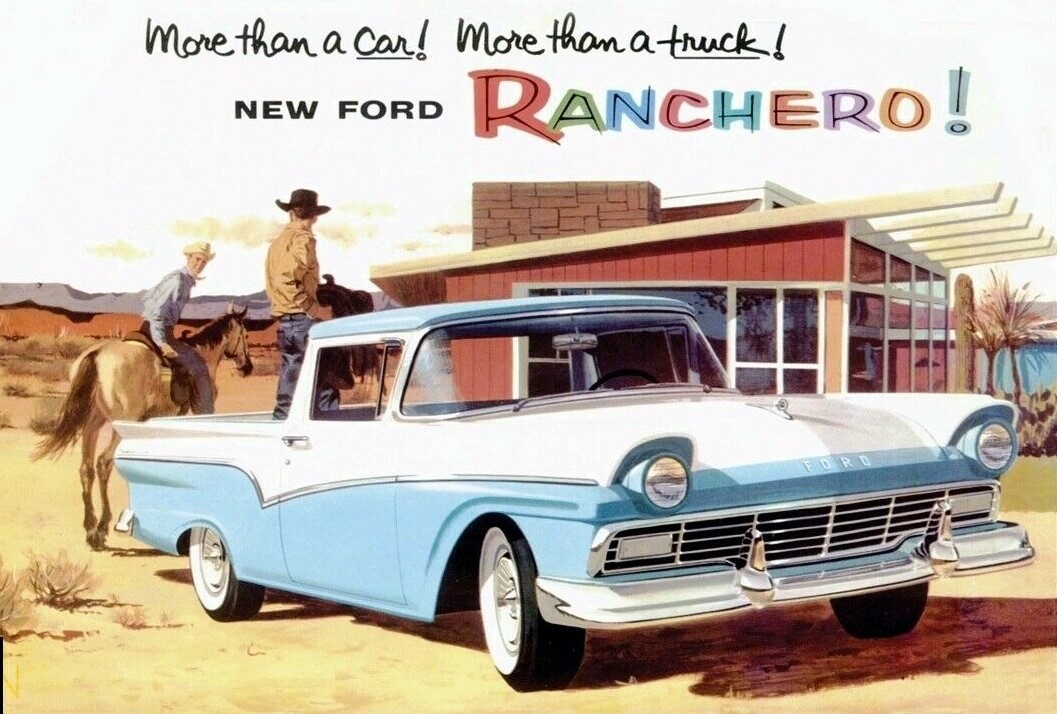
Introduced in December 1956, the Ford Ranchero combined the sleek styling of a sedan with the utility of a light-duty pickup truck. Based on Ford’s full-size passenger car platform, the car-based pickup created an entirely new niche in the American automotive market. Photo from Ford Motor Company sales brochure.
The first-generation Ranchero (1957–1959) was built on Ford’s new full-size platform and assembled in Lorain, Ohio, alongside Ford passenger cars. Sold through Ford’s truck division, the Ranchero was initially offered in two trim levels. The standard model was aimed at traditional pickup buyers, while the Custom featured additional trim, options and accessories borrowed from the Fairlane line. Both models could be ordered with any engine available in Ford passenger cars, including the high-performance 312 cu. in. “Thunderbird Special” V8.
The 1958 Ranchero offered new front sheet metal and its new four-headlamp arrangement. Ford's new FE 352 cu.in. V8 was also available. The '59 model grew in size and trim being built on the same 118 inch wheelbase as all 1959 Fords and offered a longer 7 ft. reinforced bed as standard. The Custom Ranchero became the sole model offered for 1959 and included additional options, a larger windshield, vinyl or woven-plastic seat upholstery, and a choice of 26 solid or two-tone paint combinations. The spare tire was also relocated behind the passenger seat. This marked the last time the Ranchero would significantly increase in size or trim for several years.
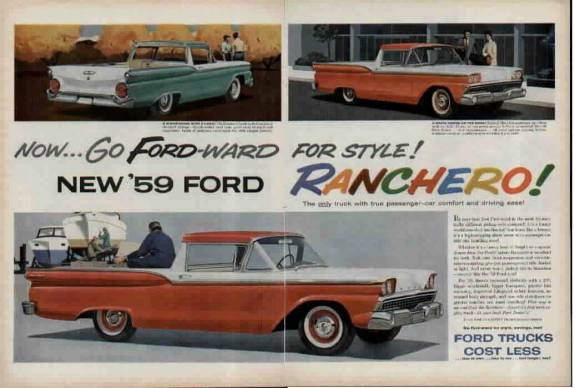
The 1959 Ford Custom Ranchero sat on a 118 inch wheelbase and came with a standard 7 ft. bed. The Ranchero was marketed through Ford's truck division. Ad photo from Ford Motor Co.
The second-generation Falcon Ranchero (1960–1965) became significantly smaller as compact, economical cars surged in popularity. Ford’s timing proved ideal, as the economic recession of the late 1950s increased demand for thrifty, fuel-efficient cars and trucks. The Falcon Ranchero delivered fuel economy of up to 30 mpg thanks to its standard 144-cu. in. Thriftpower inline-six engine, rated at 85 horsepower, paired with a three-speed column-shifted manual transmission. This generation shared its engines, transmissions, differential and much of its sheet metal with the Falcon sedan, although the Ranchero’s wheelbase and overall length were extended by eight inches to accommodate a six-foot cargo bed.
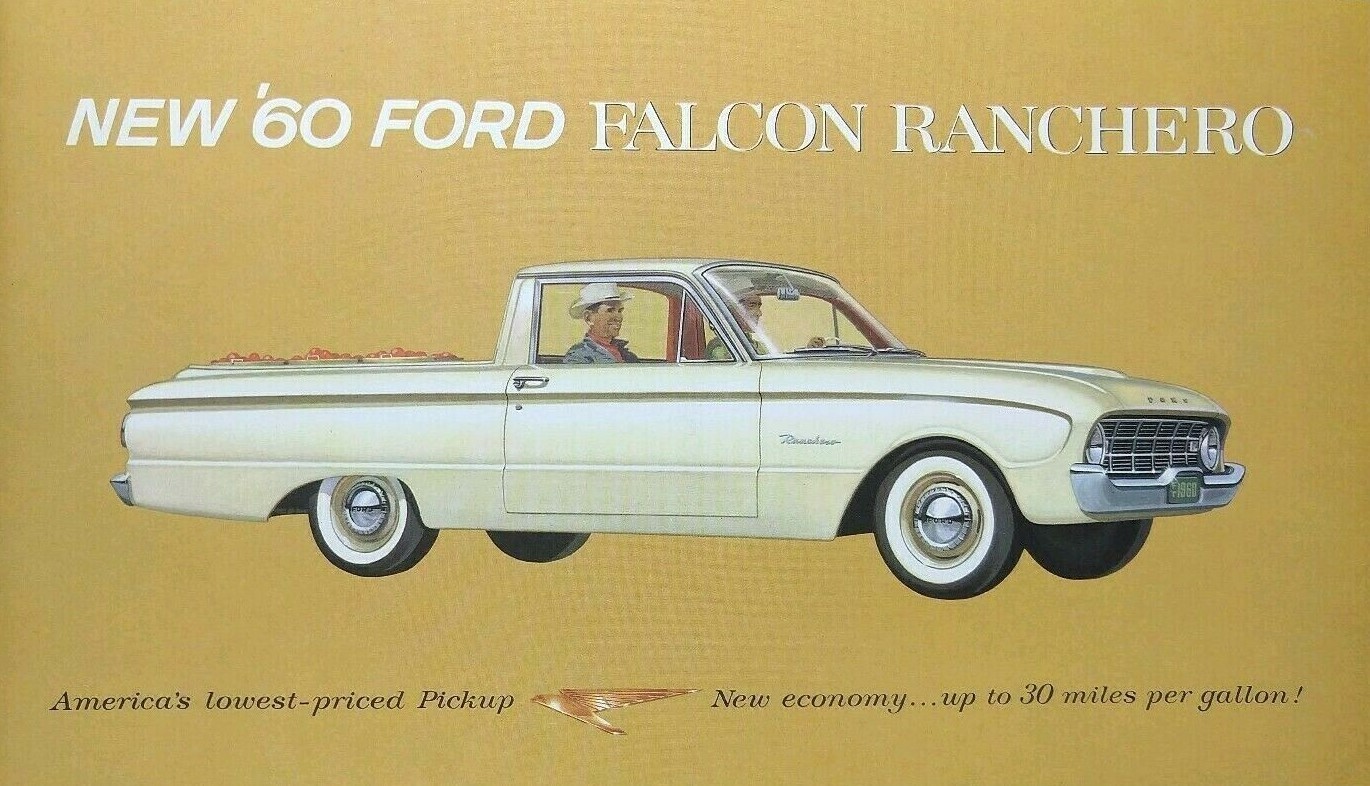
1963 was the last year for this body style and during that time Ford offered more engine and transmission choices that included the 170 cu.in. inline six rated at 105hp and in '63 added a 260 cu.in. V8 and two speed Ford-O-Matic automatic transmission or C-4 three speed Cruise-O-Matic. 1963 added some minor trim and a grill change, additional rust prevention treatments and a 800-lb. load capacity. Along with the Falcon - the Falcon Ranchero was released with an all new look in 1964. Brochure from Ford Motor Company.
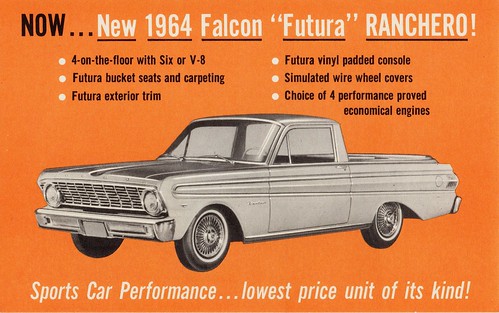
The Ranchero evolved along with the Falcon in '64 becoming a bit larger and using the same basic body style for 1964 and 1965. In 1965, the 289 cu.in. V8 replaced the discontinued 260 and an alternator replaced the generator in all Ford cars. Brochure by Ford Motor Company.
The third generation Falcon/Fairlane Ranchero (1966-1967) was developed on the same basic modified station wagon platform. For 1966 the Ranchero used Falcon front sheetmetal and was marketed simply as the Ford Ranchero. Seat belts were now standard. The 1967 Ranchero used the same basic '66 body with Fairlane trim, front sheet metal and interior treatments. Trim levels were expanded from base car to include the 500, 500 XL and GT that included the 390 cu.in. V8. More emphasis was placed on safety with a new dual-circuit braking system, safety padded windshield pillars and a center steering wheel safety pad.
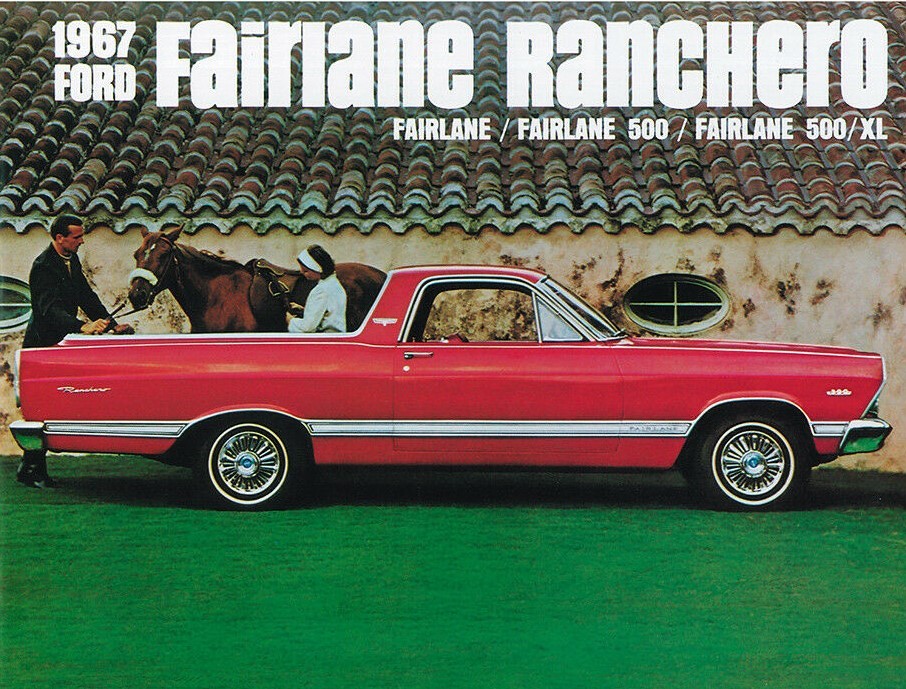
The 1967 Fairlane Ranchero was a one year vehicle that was not only stylish but offered several luxury trim levels and performance features as well. Top performance came from Fords 390 cu.in. FE-series V8 engine rated at 320 bhp. It was available with a 4-speed floor mounted standard transmission or the optional C-6 automatic. Photo: Ford Motor Company brochure.
Ford introduced the Torino in 1968 and the fourth generation Ranchero (1968-1969) followed suit. It was the largest model since the full size 1959. The Torino offered a more horizontal grill and horizontal quad-headlamps. Three trim levels were available that included the base car, Ranchero 500 and the GT. The Ranchero was available with all the options as the Torino including air-conditioning, bucket seats, center console, optional styled steel wheels and power front disc brakes. Engine choices included a 250 cu.in. inline 6-cylinder and five V8's.
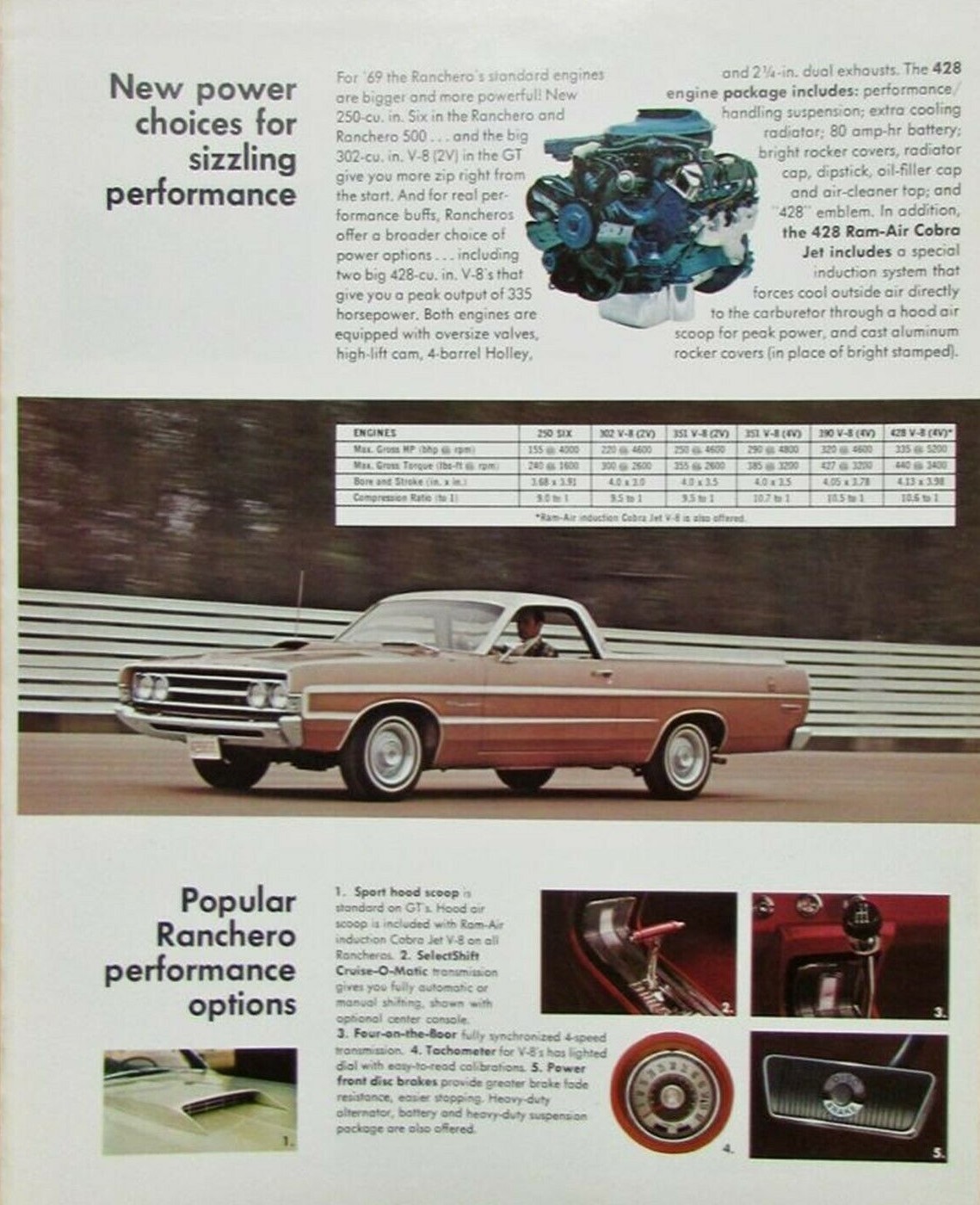
Ford offered the 428 cu.in., 335 horsepower Cobra Jet hi-performance FE V8 engine and performance/handling suspension in mid-1968. The 289 engine was discontinued and was replaced with a 302 cu.in. as the standard V8 and the new optional 351 cu.in. Windsor V8 with 2- and 4-barrel carburetor. A rare offering called the Ranchero Rio Grande was made available on special order. It included the GT option, special colors (Grabber) in white, red and coral with blacked out hood scoop, side stripes, vinyl top, bed rails and special RG wheel center caps. Less than 1000 were produced and today are quite rare and collectable. Ad photo from Ford Motor Co.
The fifth generation (1970-1971) Torino based Ranchero had a complete restyle with a shallow-pointed front end. A new trim package (4th) was offered called the Ranchero Squire that featured an upmarket trim option which included a body side woodgrain applique similar to Fords Country Squire station wagon. All other Torino trim and engine options were available including the all new Ram-air 429 Cobra Jet or Super Cobra Jet engines with the new "shaker" hood scoop. A first on the '70 model was interior badging on the glove box that identified it as a "Ranchero" or a "Ranchero GT". Prior to 1970, no Ranchero had interior badging identifying it as such. 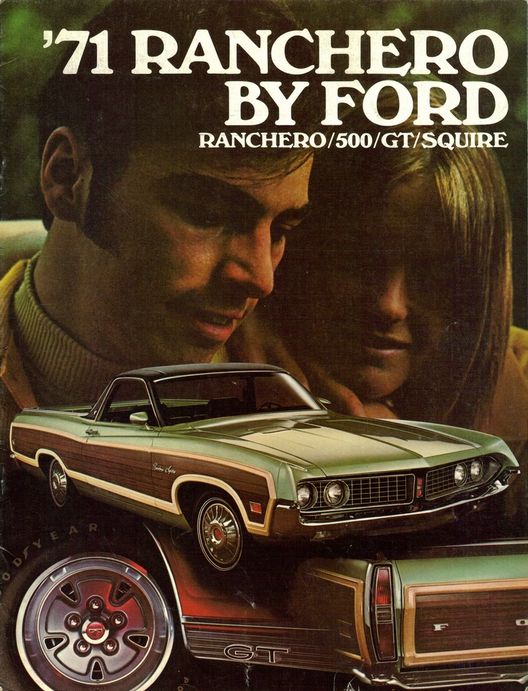
The 1971 Ford Ranchero is distinguished by a grill divided by a center section. The "Squire" option featured a top of the line trim package that included woodgrain applique.. Photo from Ford Motor Co.
The sixth generation (1972-1976) had a radical change in the Torino and Ranchero line. They had a larger heavier design with the front displaying a wide semi-oval grill commonly referred to as the "fish mouth" grill design. The attractive new body-on-frame was still available in three models: the now standard 500, the Squire and the sporty GT. The days of the hi-performance, hi-horsepower engines were now fading due to smog issues (lower compression ratios) and changes in rating horsepower. The new Ranchero had several engine options, usually fitted with the C6 of FMX automatic transmissions. The floor mounted 4-speed transmission was also available through '73 with the hefty "Hurst" shifter.
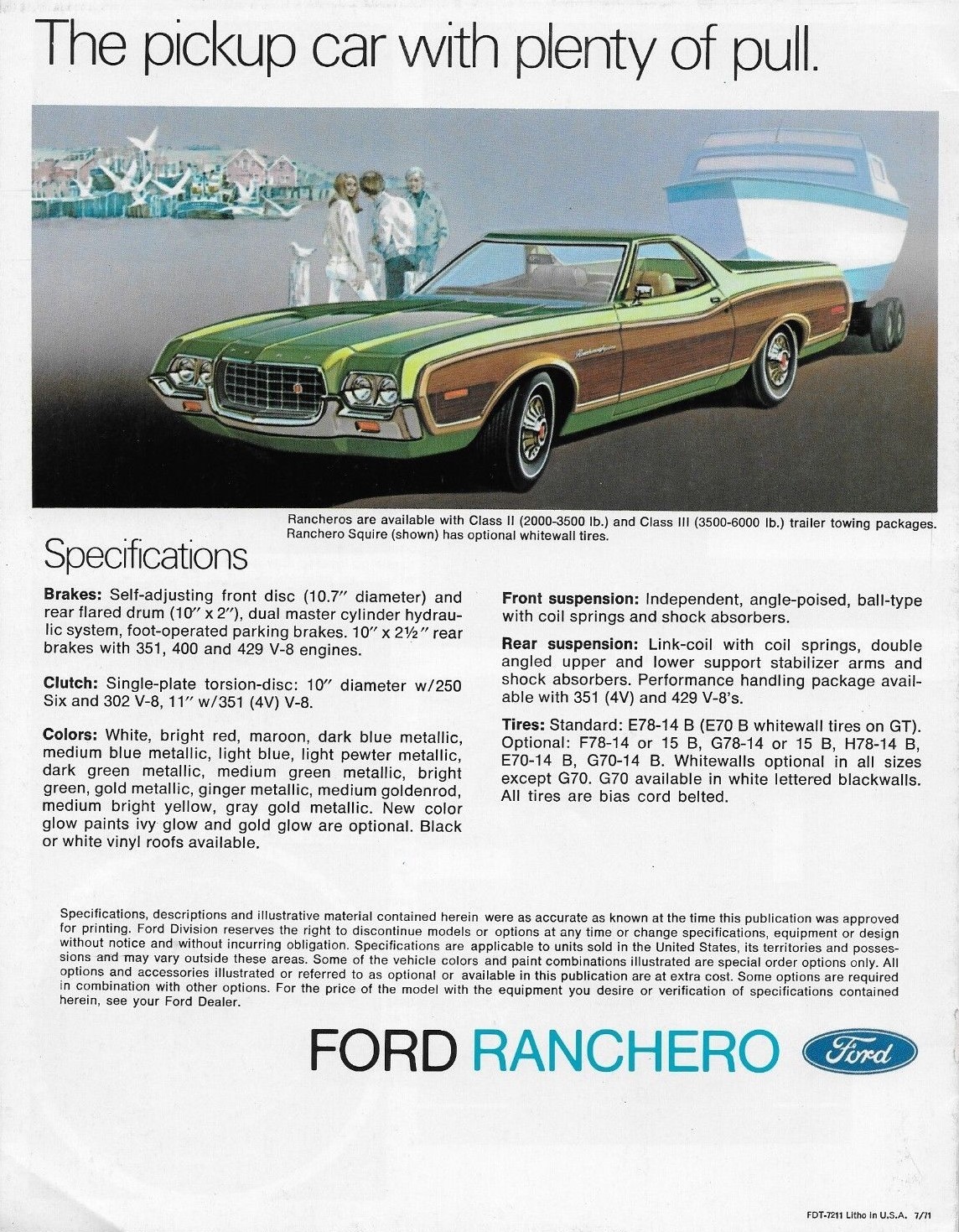
The '72 Torino/Ranchero with its "fish mouth" grill design would be changed in '73 thru '76 to meet new federal standards for front impact protection. The Ranchero also offered Class II and Class III trailer towing packages. Ad photo from Ford Motor Co.
The seventh and last generation (1977-1979) Ranchero was restyled in line with the Thunderbird/LTD II body style. It was the ultimate in truck luxury making available many of the LTD standard features such as power seats and windows, power steering, power disc brakes and tow packages. Models available were the Ranchero standard, 500 and GT that were previously offered since 1968. Three V8 engines were available up to 400 CID. Production ceased in 1979, but not without producing a "commemorative edition" 19791/2 model with all leather interior, dashboard, special paint color and trim scheme.
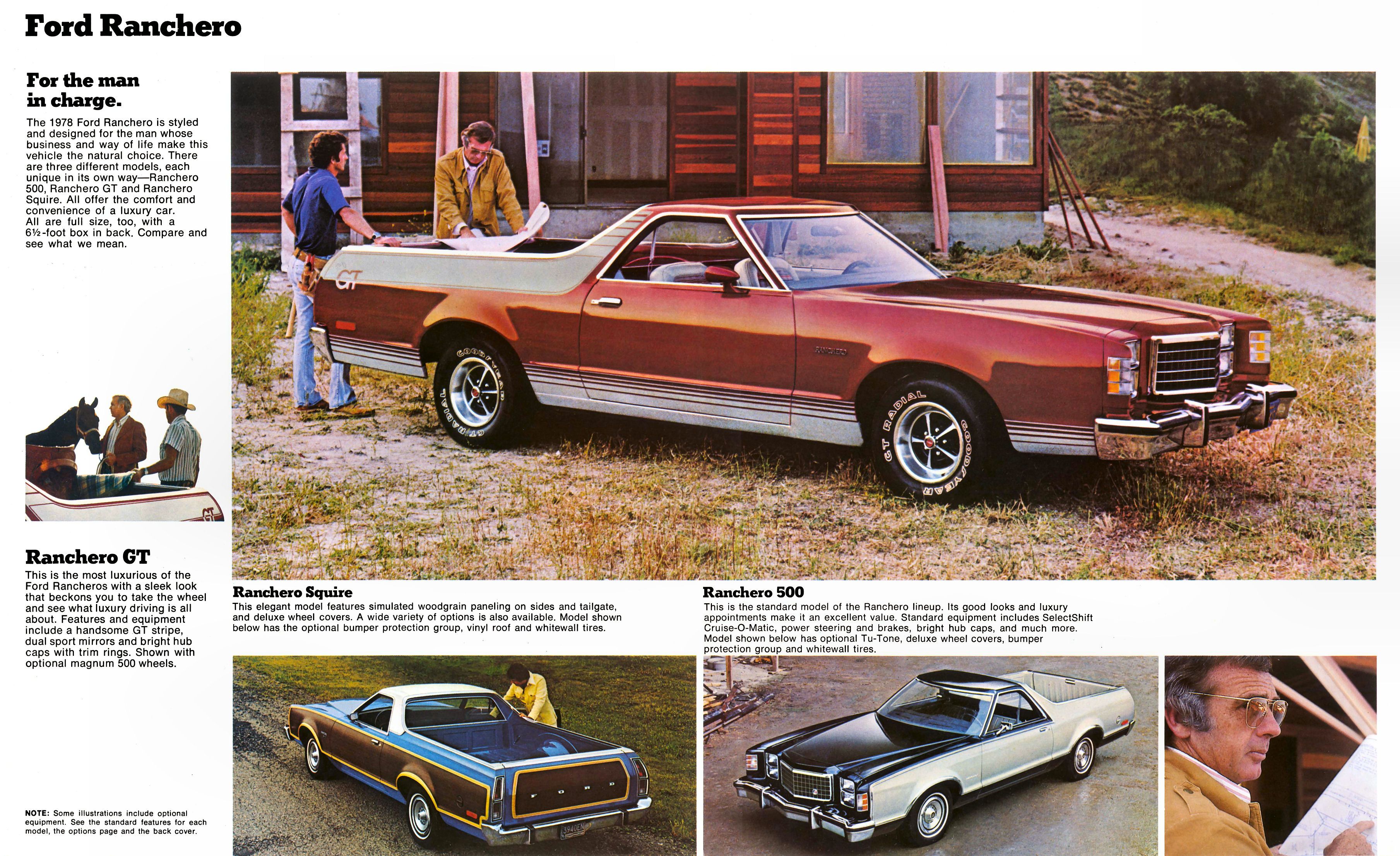
The '77-'79 Ranchero LTD-II based body style with stacked rectangular headlights is among the most popular with collectors. The market was changing and Ford decided small trucks were the wave of the future. In the 23 years of production Ford sold a total of 508,355 Rancheros. Photo from Ford Motor Company brochure.
Bibliography:
Hemmings Motor News
Ford Motor Co. ads & brochures
Mike Mueller Pickup Trucks 1999
Ford Midsize Muscle 2016 by Marc Cranswick
Muscle Portfolio 1998 by RM Clark